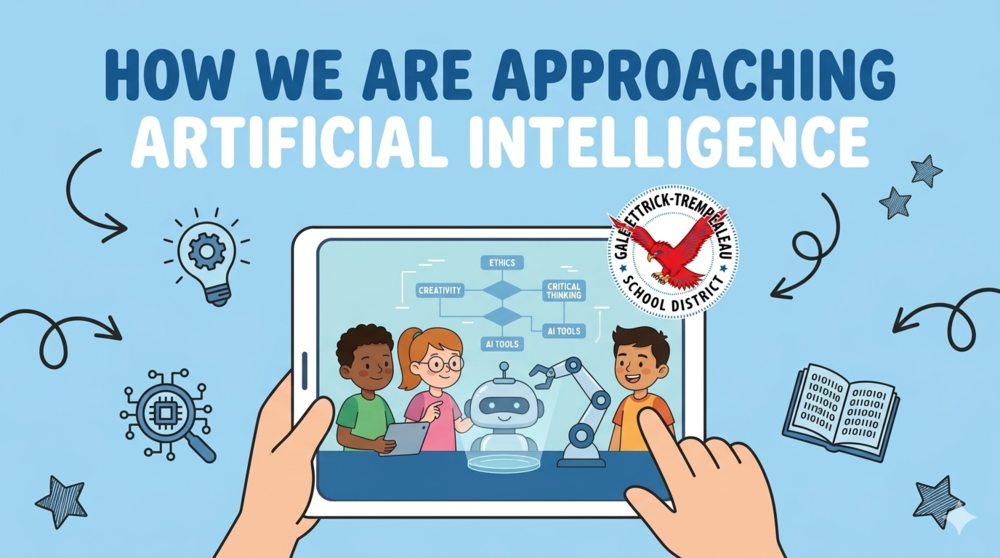
As Artificial Intelligence (AI) becomes a larger part of our daily digital landscape, the Gale-Ettrick-Trempealeau School District is committed to a proactive approach that prioritizes student safety and ethical use. Our goal is to ensure that when students interact with these tools, whether at home today or in the classroom tomorrow, they do so with a foundation of responsibility and critical thinking.
Understanding AI in G-E-T Schools
Generative AI refers to tools that can create content (like text or images) based on prompts. While these tools offer exciting possibilities for learning, they also require a clear set of guardrails to protect our students.
Our Technology Integrationist, Rob Kamrowski, recently shared an update on our district's approach to AI, focusing on transparency and student protection. You can watch that update below:
Our Strategy
We are navigating the introduction of AI through these core commitments:
Student Safety: Prioritizing data privacy and ensuring students are protected within digital platforms.
Clear Guidelines: Establishing ethical frameworks for how AI should and should not be used in an educational setting. You can see our current guidelines below.
Staff Education: Providing our educators with the professional development needed to guide them and students through this evolving landscape.
Responsive Planning: AI changes fast! We view our guidelines as a "living document" that we will regularly update as technology and best practices evolve.
Practical Guidelines for Home and School
While students in our district do not currently have access to AI chatbots on school-issued devices, many may encounter these tools on personal devices at home. We encourage parents to use the following "Do’s and Don’ts" to spark conversations about responsible use:
The DO’s (How to use AI as a Tool):
Brainstorming: Use AI to spark ideas for a project or to help get over "writer's block."
Research Assistance: Use it to find information or summarize complex articles—but always verify the facts with a trusted source like a textbook or library database.
Skill Practice: Use AI as a "tutor" to explain a difficult concept in simpler terms or to get feedback.
Transparency: Encourage your child to always be open with their teachers if they used an AI tool to assist them with their work.
The DON’Ts (Avoiding the Pitfalls):
Replacing the Work: AI should never be used to write entire essays, solve math problems, or complete assignments. Using AI to do the work for you is considered cheating, and robs you of the learning experience you need to grow as a student.
Sharing Personal Privacy: Never enter full names, phone numbers, home addresses, or any information that could be used to identify you into an AI tool.
Creating Misinformation: AI should not be used to create fake or misleading content that may be harmful to others.
By treating AI as a tool for support rather than a replacement for thinking, we can help our students develop the digital citizenship skills they need for the future.
Resources
Explore our official resources on this topic. Also, use our brand NEW Online Safety Hub website to find articles and resources about many topics involving digital citizenship and safe, ethical technology use.
G-E-T Artificial Intelligence Guidelines
Note: Artificial intelligence was used in the creation of this post.