
When families think about technology in school, an understandable question might be, “Is this good for learning?”
In our district, we approach that question a little differently.
Instead of asking whether technology is simply “good” or “bad,” we focus on how it is being used to support learning for all, learning for life. Because the truth is, technology can support deep learning or it can be a distraction. The difference is in the purpose behind its use.
A Simple Way to Understand Technology Use
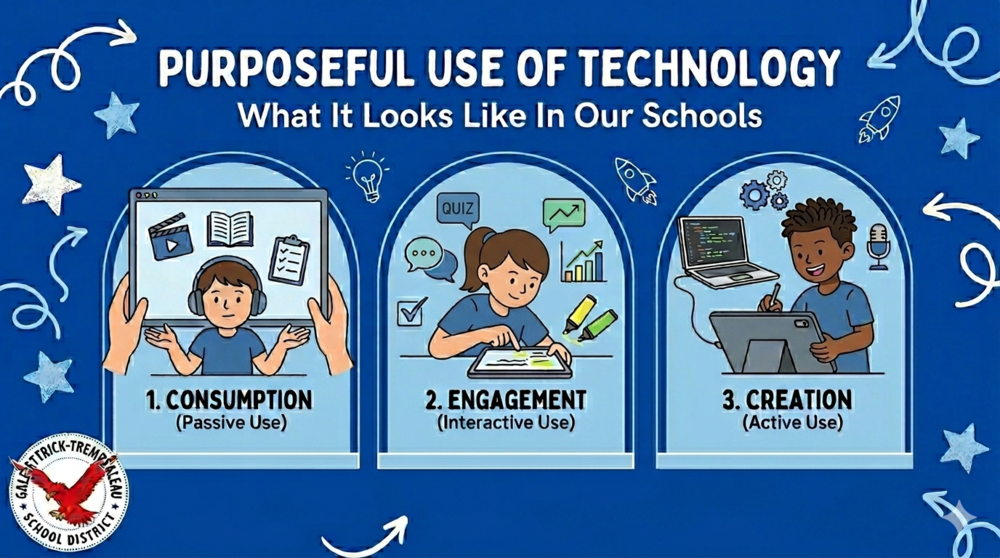
As you watch the video and explore the graphic below, you’ll notice three different ways technology can be used for learning. These aren’t “levels” students move through, but rather different types of experiences we design depending on the learning goal.
1. Consumption (Passive Use)
This is when students are receiving information.
Watching a video
Reading digital text
Listening to a podcast
Completing a digital worksheet
There is value here, students need background knowledge and exposure to new ideas. But on its own, this type of use does not always require students to think deeply or apply their learning.
2. Engagement (Interactive Use)
This is when students begin interacting with content.
Taking an interactive quiz
Using simulations
Playing educational games
Annotating or responding to text
At this level, students are getting immediate feedback and making connections. Technology becomes more responsive, helping guide their learning in real time.
3. Creation (Active Use)
This is where some of the most powerful learning often happens.
Creating videos or podcasts
Designing presentations or websites
Building multimedia projects
Coding or developing original work
Here, students are not just consuming information, they are applying, explaining, and creating. They have voice and choice in how they show what they know, and they are often collaborating with others.
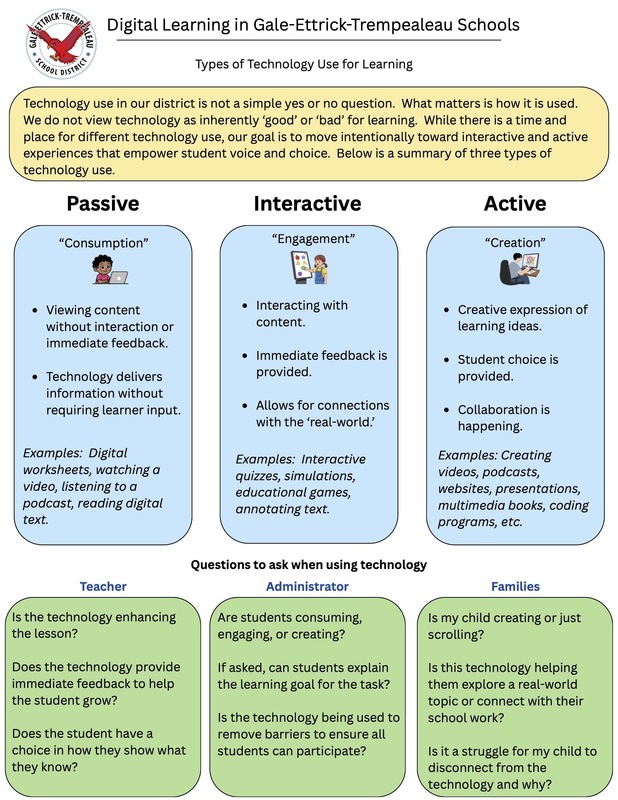
Our Goal: Purposeful Learning With Technology
All three types of technology use have a place in learning. However, our goal is to intentionally move toward more interactive and active experiences whenever it makes sense.
Why?
Because that’s where students:
Think critically
Solve problems
Express their ideas
Connect learning to the real world
Questions We Ask at School (and You Can Too)
To keep technology use purposeful, we reflect on questions like:
Is the technology enhancing the lesson, or just replacing something we already did?
Does it provide feedback that helps students grow?
Do students have choice in how they demonstrate their learning?
Can students explain what they are learning and why?
Is the technology helping remove barriers so all students can participate?
Questions Families Can Ask at Home
You don’t need to be a technology expert to support your child. Sometimes, a few simple questions can open up powerful conversations:
“What are you creating right now?”
“How is this helping you learn?”
“Is this connected to something you’re doing in school?”
“Are you interacting with it, or mostly just scrolling?”
These conversations help children become more aware of how they use technology, not just how much they use it.
What This Means for Your Child
In our schools, technology is not the goal—learning is.
Technology is simply one of the tools we use to:
Personalize learning
Support creativity
Build real-world skills
Ensure all students can access and engage in their education
When used with purpose, technology helps students move from simply receiving information to thinking, creating, and thriving.
As you see your child using technology, at school or at home, this framework can help you better understand what kind of learning is happening.
If you ever have questions about how technology is being used in your child’s classroom, we encourage you to reach out. We value our partnership with families as we prepare students for a future where technology is part of everyday life.
Note: Artificial intelligence was used in the creation of this post.